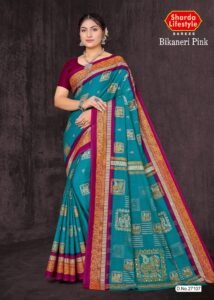
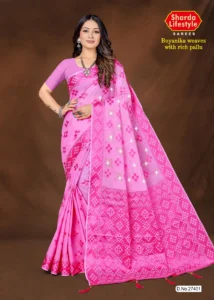
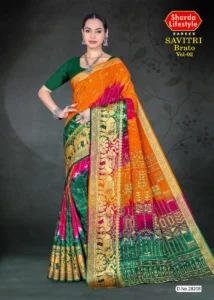
When Simplicity Meets Grandeur
For centuries, Indian weddings were synonymous with heavy Kanjeevarams and Banarasi brocades in deep reds and maroons. While these classics are timeless, the modern Indian woman is evolving. She seeks elegance that breathes. She looks for luxury that doesn’t weigh her down.
Enter the Chikan Kari Saree.
Once reserved for summer afternoons and casual wear, Chikan Kari has undergone a royal transformation. With the infusion of Mukaish (gold/silver wire work) and heavy borders, it has stormed the wedding trousseau market.
At Sharda Sarees, with our legacy spanning 25 years in Cuttack, we have witnessed this shift firsthand. Our artisans are no longer just weaving cotton; they are crafting heirlooms. Today, we dive deep into the world of shadow work and silk, specifically focusing on our masterpiece: the Chikan Kari Gold Saree.
In this guide, we will master Chikan Kari saree with golden border styling, explore unique color palettes like violet and blue combination saree looks, and compare them with traditional silk sarees for wedding reception wear.
1. The Art of the White Thread: A Brief History
To understand the value of the saree you are draping, you must understand its roots. Chikan Kari, often associated with the City of Nawabs (Lucknow), is an art form believed to have been introduced by Noor Jahan, the wife of Mughal Emperor Jahangir.
It is delicate, intricate, and painstakingly slow. A single high-quality Chikan Kari saree can take an artisan 3 to 6 months to complete. When we at Sharda Sarees say “Weaving Tradition, Creating Elegance,” we refer to this patience.
Unlike machine embroidery which is flat, hand-embroidered Chikan Kari has texture. It includes 32 different stitches, including Tepchi (running stitch), Bakhiya (shadow work), and Hool (eyelet). When you wear this, you are wearing a piece of history.
2. Mastering the Look: Chikan Kari Saree with Golden Border Styling
The primary hesitation women have with Chikan Kari for weddings is: “Is it too simple?”
The answer lies in the styling. The modern Chikan Kari saree is not just plain white thread on pastel cotton. It is evolved.
Take, for example, the Chikan Kari Gold Saree from the Sharda Sarees collection. It features the traditional thread work but is elevated with a rich golden border and intricate detailing. Here is how to style it for a wedding:
The Blouse Game
The golden border on the saree allows you to experiment heavily with the blouse.
- Velvet Contrast: Since the Chikan Kari fabric is usually Georgette or Silk, pairing it with a heavy velvet blouse in a darker shade creates a rich texture contrast.
- Full Gold Sequin: To make the look festive, wear a blouse fully embellished with dull gold sequins. This picks up the golden border of the saree and ties the look together.
The Drape
- Open Pallu: Chikan Kari is all about the details. Draping it with an open pallu allows the Jaal (mesh) work to be fully visible.
- The Shawl Addition: For winter weddings, drape a heavy Pashmina or a Velvet shawl on the other shoulder. This screams royalty and mimics the style of the Mughal queens.
Jewellery
- Since the saree styling is about elegance, go for Jadau or Polki jewellery. The uncut diamonds set in gold complement the “Golden Border” perfectly without looking flashy.
3. Breaking Stereotypes: Violet and Blue Combination Saree Looks
Red is traditional. Pink is safe. But Violet and Blue? That is for the woman who commands attention.
In our exclusive collection, we feature the Chikan Kari Gold Saree in Violet and Blue. This dual-tone combination is rare and visually striking. Here is why this color palette works wonders for evening events:
The Royal Color Theory
Historically, purple and violet were the colors of royalty because the dye was expensive to produce.
- Night Appeal: Unlike pastels which can look washed out under bright wedding halogen lights, Violet and Royal Blue absorb light and reflect a deep, rich sheen.
- Skin Tone: This cool-toned combination is universally flattering on Indian skin tones, making the complexion look brighter.
Styling the Violet-Blue Duo
- Makeup: When wearing such a strong color, keep the lips neutral or nude. Let the eyes do the talking with a smokey look that mirrors the blue of the saree.
- Accessories: Silver or White Gold jewellery stands out brilliantly against the dark violet background.
4. The Competition: Traditional Silk Sarees for Wedding Reception
While Chikan Kari is the rising star, we cannot ignore the reigning queen: Silk. At Sharda Sarees, we produce 15,000+ units a month, and a large chunk of that demand is for silk.
If the Chikan Kari Gold is for the Sangeet or the Morning Wedding, the traditional silk sarees for wedding reception are for the grand finale.
Why Silk Rules the Reception
Receptions are usually formal, stage-based events. You need a fabric that has structure and sheen.
- Kanjeevaram & Banarasi: These are characterized by heavy Zari work. They reflect light, making the bride or guest shine in photos.
- The “Emerald Grace“: From our collection, the Calicut Flower Emerald Grace silk saree is a prime example. The emerald green with floral weaving offers a heavy, structured look that photographs beautifully.
Comparing the Two
- Comfort: Chikan Kari (on Georgette) is lighter and huggier. Ideal if you plan to dance.
- Volume: Silk adds volume and grandeur. Ideal if you want to look majestic and tall.
5. Festivals and Fabric: Best Silk Sarees for Festivals in India
India is a land of festivals, and every festival demands a different vibe. You cannot wear a bridal heavy silk to a Diwali party, and you cannot wear a daily cotton to a Puja.
Here is a quick guide to the best silk sarees for festivals in India, curated from the Sharda Sarees catalog:
- Diwali (The Festival of Lights): You need shimmer.
- Recommendation: Calicut Flower Velvet Bloom. The rich floral weave mimics the festive spirit without being as heavy as a bridal saree.
- Durga Puja / Navratri: You need vibrant colors and ease of movement for Pandal hopping.
- Recommendation: Tirupati Gold Cotton. While technically cotton, the “Gold” weave gives it a silk-like sheen, making it perfect for the humidity of October while looking festive.
- Raksha Bandhan / Ganesh Chaturthi:
- Recommendation: Calicut Flower Pearl Essence. The soft pearl shade is sophisticated, auspicious, and perfect for day-time rituals.
6. The Investment: Chikan Kari Embroidery Saree Price Guide
One of the most searched topics is the Chikan Kari embroidery saree price. Customers are often confused why one Chikan saree costs ₹1,500 and another costs ₹15,000.
As a manufacturer with 25 years of legacy, Sharda Sarees believes in transparency. Here is what determines the price:
1. The Fabric Base
- Cotton/Synthetic (₹800 – ₹2,500): These are machine-embroidered or semi-handcrafted. Good for daily wear but lack the “heirloom” quality.
- Pure Georgette/Silk (₹5,000 – ₹25,000+): The fabric itself is expensive. Our Chikan Kari Gold uses premium fabric that falls fluidly and lasts for decades.
2. The Embroidery Technique
- Machine Work: It is uniform, flat, and cheap.
- Hand Work: Look at the reverse side of the saree. If you see knots and slight irregularities, it is hand-done. Hand embroidery takes months, and you are paying for the artisan’s time and skill.
3. Embellishments
Plain thread work is cheaper. The moment you add Mukaish (metal wire), Kamdani, or Pearls (as seen in our Calicut Flower Pearl Essence), the price rises because these are added by hand, one by one.
- The Verdict: When buying a Chikan Kari saree for a wedding, view it as an investment. A ₹1,200 saree will last a season. A premium saree from Sharda Sarees will be passed down to your daughter.
7. Care and Maintenance of Your Royal Weaves
You have bought the perfect Violet and Blue Chikan Kari saree. Now, how do you ensure it stays new forever?
- Dry Clean Only: Never hand wash a heavy Chikan Kari or Silk saree. The thread work can loosen, and the colors (especially deep violets and blues) can bleed.
- Folding: Change the fold of the saree every 3 months. If kept in the same fold for years, the fabric may tear at the crease lines.
- Wrapping: Wrap your expensive sarees in muslin cloth (or old soft cotton sarees). Do not use plastic covers, as they can trap moisture and cause fungal growth on the silk.
The Legacy of Sharda Sarees
Whether you choose the intricate Chikan Kari Gold Saree in Violet and Blue for its artistic brilliance or the Calicut Flower Emerald Grace for its traditional silk authority, you are making a statement. You are stating that you value tradition, but you style it on your own terms.
At Sharda Sarees, located in Grand Bazar, Phulnakhara, Cuttack, we are honored to be a part of your celebrations. With over 10,000 satisfied customers, we promise that every thread we weave is a thread of trust.
Ready to find your dream wedding saree?
Explore our exclusive “New Arrivals” and “Latest Trending” collections today.
Visit our website: www.shardasarees.com
Contact us: +91 97766 65430
Email: info@shardasarees.com